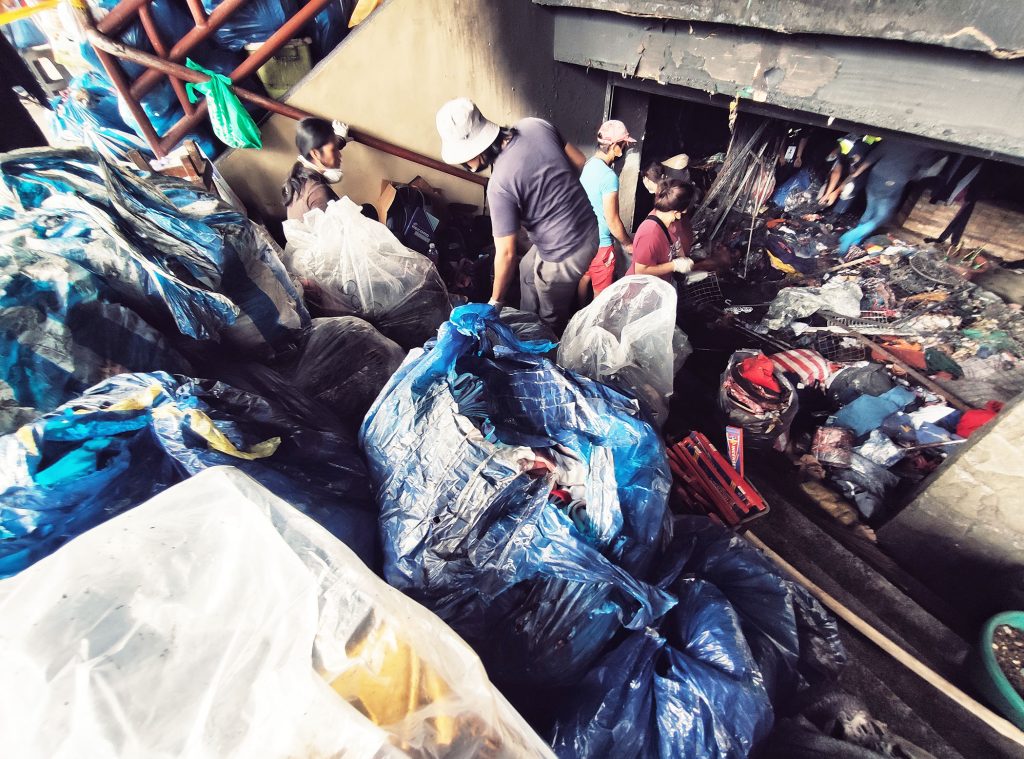
The tenants retrieved salvageable goods from their stalls at the Maharlika Livelihood Complex basement on Tuesday, September 9, 2025. A fire broke out in its basement on Saturday night at 9pm, September 6, 2025. **photo by neimless_skills
The National Economic and Development Authority (NEDA), through its Investment Coordination Committee (ICC), has delisted Baguio City’s proposed Sewerage Treatment Plant (STP) Rehabilitation Project from its official project list following delays in securing approval from the Baguio City Council and the missed deadline by the Department of Tourism (DOT) to submit the proposal. This has halted the city government’s chance to secure national financing in the amount of P2.9 billion for the implementation of the project through the Asian Development Bank (ADB).
In its letter dated July 10, 2025, the ICC-Technical Board (ICC-TB) of NEDA directed DOT to reconfirm its intent to pursue the project and submit a complete proposal by July 31, 2025, warning that failure to submit would lead to delisting from the Investment Coordination Committee Project Appraisal Monitor (IPAM). When the deadline passed without the required documents, the project was struck off the list or removed from the active pipeline of the national government.
The proposed rehabilitation of the city’s outdated STP seeks to address the city’s long-standing wastewater management problems and avert looming penalties from the Department of Environment and Natural Resources (DENR) for continued noncompliance with effluent standards. The project aims to expand the STP’s capacity, rehabilitate sewer networks, introduce smaller community-based treatment systems in underserved areas, and implement sludge-to-fertilizer or biofuel programs.
To fund the initiative, the city government’s executive department was eyeing an ADB loan supplemented by grants from the UK-ASEAN Catalytic Green Finance Facility and the Tourism Infrastructure and Enterprise Zone Authority (TIEZA), alongside local government contributions. Previously, the city had sought the help of TIEZA in a bid to access funding since the ADB can only provide loans to the national government.
In its memorandum dated August 12, 2025, TIEZA, the infrastructure arm of DOT, stated that the project had been delayed mainly because the city government failed to get the Baguio City Council to authorize Mayor Benjamin Magalong to sign the MOA with TIEZA.
The project has been scrutinized by the city council for a span of three years since its inception in 2021. Several city council members raised strong reservations over the proposed foreign loan for the project, citing financial and procedural red flags. Some councilors warned that the loan could “mortgage Baguio’s future” and objected to approving MOAs ahead of loan terms while also criticizing the inclusion of operational expenses like office furniture and meetings in the package which should be locally funded instead. The city council pressed for transparency, fiscal prudence, and clarity of loan mechanics before binding the city to long-term debt.
Along with the city council’s reservations, the executive department also requested changes in the project design, specifically the removal of Output 2 which was the Skills Development Training, but such revisions required re-evaluation which further slowed down the process.
These issues delayed the project’s timeline to the point that DOT could not meet the ICC’s deadline for submission on July 31, leading to the ICC’s decision to delist the project from the national pipeline.
With the project delisted, the city government may need to explore alternative financing options. However, none have been identified to date. The executive department is still studying possible financial mechanisms, but no clear direction has been set yet.
The city government may also resubmit the project to NEDA with its updated feasibility study, documentary requirements, and endorsement which means restarting the process at the regional level through the Regional Development Council (RDC). City Budget Officer Leticia Clemente said pursuing the ADB loan is still the best option due to its lower interest rate compared to others, recommending the approval of the MOA in anticipation of refiling the project.
As the local government grapples with financial challenges for this project, the city risks non-compliance with DENR Administrative Order 2016-08 (Water Quality Guidelines and General Effluent Standards of 2016) issued under the Philippine Clean Water Act (RA 9275). Failure to comply with these standards exposes the city to hefty fines ranging from P10,000.00 per day (P3.65 million annually) to as much as P200,000.00 per day (P73 million annually) depending on the severity of violations which could drain the city’s coffers and divert funds away from other essential services.
The city government now faces the challenge of convincing the Environmental Management Bureau (EMB) that it is actively pursuing ways to rehabilitate the facility to avoid possible penalties.
Moreover, without timely completion of the STP rehabilitation, the city’s existing facility remains outdated and inadequate to handle the city’s growing population and waste generation. This prolongs the problem of untreated or partially treated wastewater being discharged into waterways which directly contributes to pollution of rivers, foul odors, and potential health hazards for communities. **Jordan G. Habbiling