
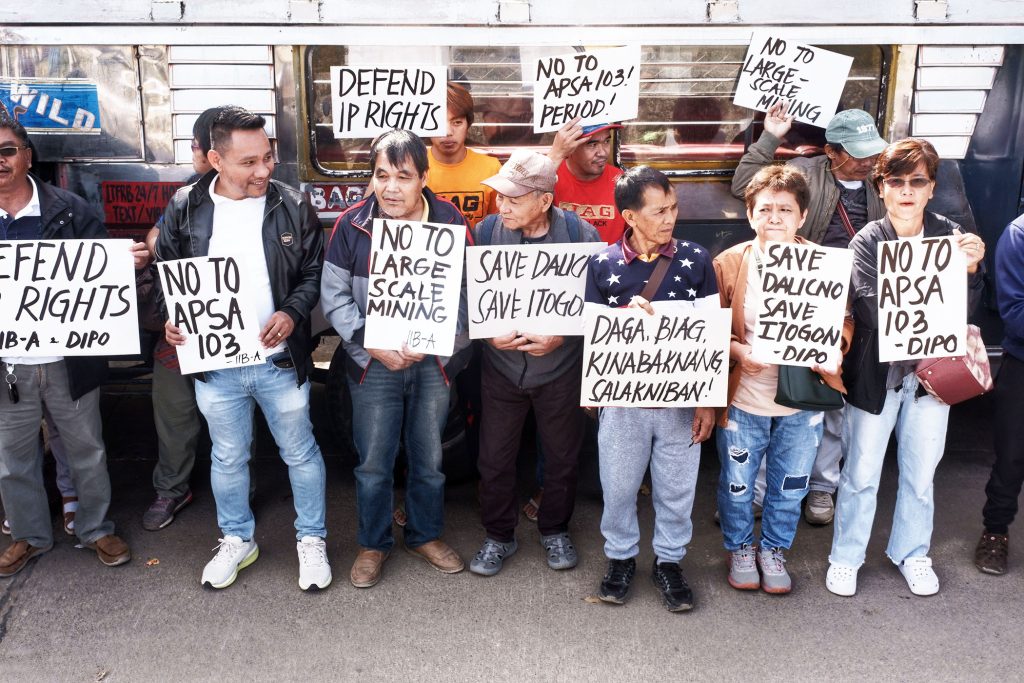
On January 27, 2026, during the public scoping of the DENR's Environmental Impact Assessment (EIA) for ITOGON-SUYOC RESOURCES INC., the proposed Sangilo Mines expansion project (APSA 103) was met with protests by hundreds of indigenous communities from Itogon, Benguet.** Photo by neimless_skills
According to the Philippines Statistics Authority (PSA), Baguio City ranked among the country’s top 10 cities in terms of per capita gross domestic product (GDP), emerging as the only city outside the National Capital Region (NCR) to make the list.
During the regular session of the Baguio City Council on January 26, 2026, Aldrin Federico Bahit Jr., Chief of the Fiscal Operation and Coordination of PSA-Cordillera, stated that Baguio’s economy is thriving with an upward trajectory despite a slowdown.
He explained that Baguio’s per capita is estimated at P485,433.00, placing it ahead of other provinces in the Cordillera Administrative Region (CAR) and several highly urbanized citizens (HUCs) in Metro Manila.
While Baguio ranked 15th in total gross domestic product among the country’s highly urbanized cities, Bahit noted that its relatively smaller population combined with strong economic output gave it a higher per capita GDP which allowed the city to outperform larger cities such as Quezon City, Caloocan, Las Piñas, Malabon, Marikina, Navotas, and Valenzuela.
Bahit also attributed the city’s performance to its services-driven economy which accounts for about 75% of Baguio’s total economic output. Significant contributors are wholesale and retail trade, financial and insurance activities, professional and business services, accommodation and food services activities, education, and other service-related industries.
The PSA report was a response to a concern raised by Councilor Vladimir Cayabas on reports claiming there was a significant slowdown in the city’s economic growth from 2023 to 2024.
Bahit clarified that Baguio already achieved high growth in previous years, making further acceleration harder due to the baseline effect.
He emphasized that although Baguio’s overall economic growth slowed to 5.8% in 2024 from 9.0% in 2023, the city’s economy continued to expand and did not experience contraction.
Furthermore, he said Baguio remains the fastest-growing economy in the CAR, contributing to 47.3% of the region’s total economic output, followed by Benguet at 33%.
Asked about tourism, Bahit said it overlaps with sectors such as accommodation, food services, transportation, and finance.
For future growth directions, he proposed that the city support alternative activities beyond just real estate or land expansion such as focusing on ICT, digital products, and intellectual property; developing creative industries such as game development and cultural products; leveraging Baguio’s status as an education center to produce IT talent; strengthening financial and insurance services; and exploring opportunities in offshore banking and financial services.
The Baguio City Council referred the matter to a committee for further study and possible legislative recommendations. **Jordan G. Habbiling