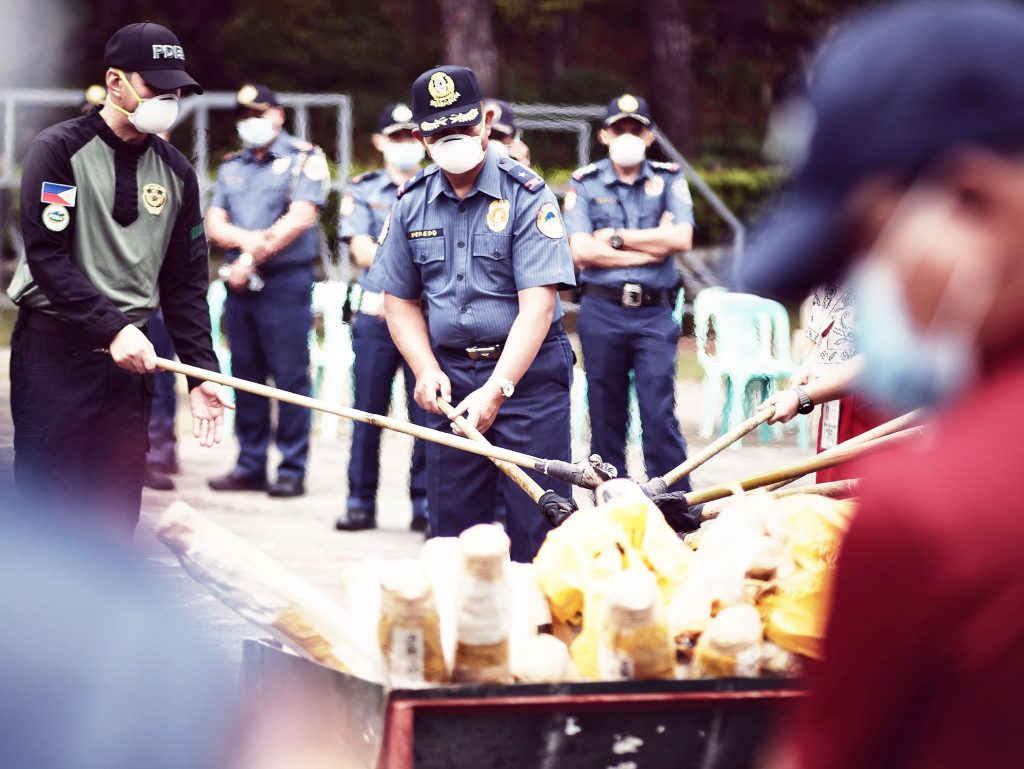
Approximately thirty (30) kilograms of dried marijuana stalks and fruiting tops were destroyed at the PRO-CAR grounds on July 14, 2025, in compliance with court instructions. Together with the PNP Regional Office-CAR, the Philippine Drug Enforcement Agency-Cordillera assisted in destroying the dangerous drugs. **Photo by neimless_skills
In a bid to bolster transparency in the operations of the City Government of Baguio by enabling access to public records and proactive disclosure of essential information, a proposed ordinance seeks to provide a standard procedure for requesting and accessing information.
The proposed ordinance authored by Councilor Leandro Yangot Jr. was approved by the Baguio City Council on first reading during the regular session on July 14, 2025. A similar initiative was filed in 2019 by then Councilor Mylen Victoria Yaranon who introduced her own version of a local FOI ordinance. However, it has remained pending at the committee level since then.
Now in his second term as a city councilor, Yangot hopes to have this FOI proposed ordinance enacted into law, asserting that access to information is not a privilege but a fundamental right.
“Transparency enhances public trust and is essential to good governance,” he stated.
The proposed ordinance is anchored on the 1987 Philippine Constitution, particularly Article II Section 28 and Article III Section 7.
While there is no national FOI law yet, there are policies and systems under Executive Order No. 2, Series of 2016 issued by then President Rodrigo Duterte that enable citizens in the country to access public records and information held by government agencies.
According to the proposed ordinance, every Filipino has the right to access information held by any office of the City Government of Baguio but with reasonable limitations.
The proposed ordinance refers to accessible information as any material (regardless of form) that a government office creates or receives while conducting public business and has in its custody or control.
However, the ordinance excludes the following to the right to information:
-matters affecting national security and international relations, especially when disclosure may prejudice these interests and the information is specifically exempted by law or executive order as determined by competent authorities;
-information related to law enforcement and due process, particularly when its release could hinder criminal investigations, prosecute offenders, or compromise the right to a fair trial;
-personal information of a private nature resulting in an unwanted invasion of privacy, unless the concerned individual consents in writing, the information is already public, or its disclosure is required by law;
-trade secrets and commercially or financially confidential information which would substantially harm the competitive position of the individual or entity that provided it;
Government agency information classified as confidential by law or court rules, especially internal deliberations, draft policies, or inger-agency communications whose premature disclosure could undermine official actions;
Information protected by executive privilege as recognized by the Supreme Court; and
-ongoing deliberations of the City Council or any of its committees, especially if premature access would prejudice the outcome. Records should be made public once decisions are finalized unless another exception applies.
Under the ordinance, to request information, a person must submit a written application to the concerned government agency or office, clearly describing the information sought such as the subject and time period and providing their name, contact details, a valid government-issued ID, and preferred mode of release.
The ordinance specifies that while stating the purpose is encouraged, a request cannot be denied solely for lack of or irrelevance of purpose.
Upon receiving the request, the office must issue a written acknowledgment with the date, reference number, and contact person. The office is then required to act on the request within 15 working days, either granting access to the information or issuing a denial with a specific legal justification. In exceptional cases involving voluminous information, the response period may be extended to a maximum of 20 working days.
If the requested information is not in the custody of the receiving office, the request must be transferred to the appropriate agency within three working days, with the requester duly informed. The response period begins upon receipt by the proper agency. A request may only be denied if it falls under the stated exceptions, and such denial must be in writing, citing the legal basis and available remedies.
The ordinance also specifies that request for information is free, but reasonable reduction and mailing fees may be charged, except for indigent requesters who present valid proof of indigency.
Furthermore, government agencies or offices are mandated to proactively disclose public information such as agency functions, officials, budgets, procurement records, citizen’s charters, consultations, ordinances, and other relevant data through accessible platforms like social media, websites, and bulletin boards. They must maintain organized records, publish an Freedom of Information (FOI) manual outlining requests and ensure compliance.
Requesters whose access is denied may file an appeal with the head of the agency or office, then with the City Mayor, and may also pursue legal action.
Public officials or employees who wrongfully deny access, delay action, tamper with records, or harass requesters may face administrative and criminal penalties.
The proposed ordinance has been referred to the city council’s Committee on Public Protection and Safety; Peace and Order; and Human Rights and Justice for review. **Jordan G. Habbiling