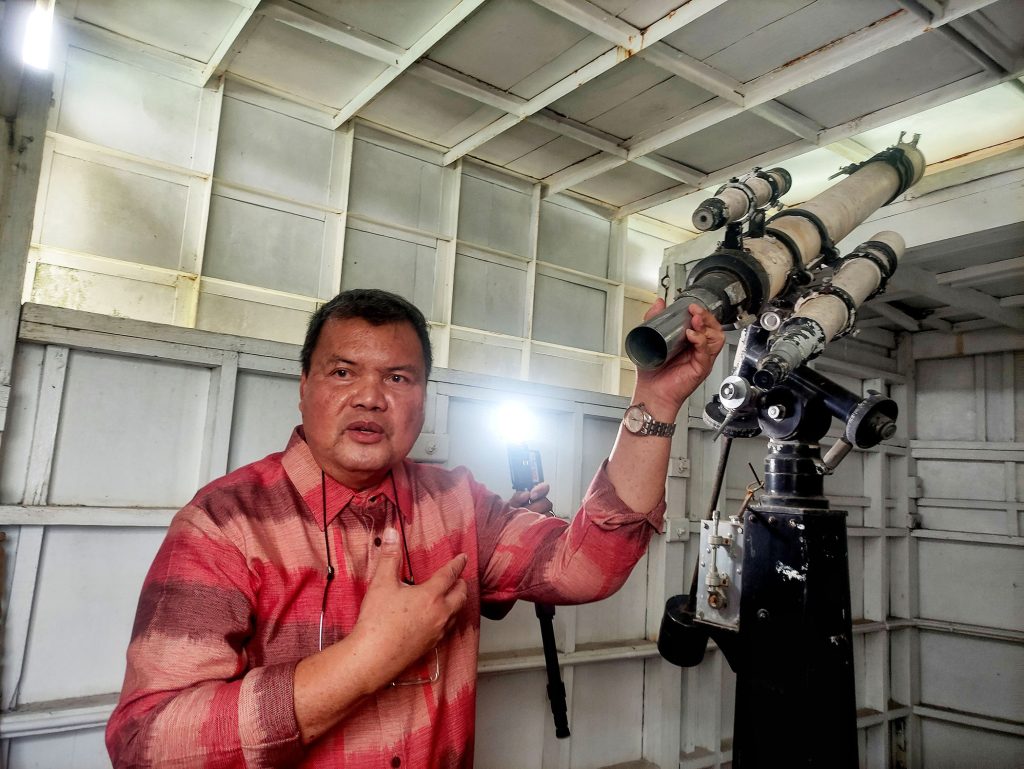
Few people are aware that the historic Mirador Jesuit Villa Retreat House and Eco Park features an earthquake monitoring station with a Nanometrics Trillium 120PA seismometer and an astronomical observatory. On Wednesday, July 22, 2026, Fr. Jose Quilongquilong showed the media around Mirador Jesuit Villa in Baguio City.**Photo by neimless_skills
Scheme disguised as online dating
BAGUIO CITY (PIA) — The Commission on Filipinos Overseas (CFO) is urging the public to remain vigilant against human trafficking, particularly the illegal “mail-order spouse” scheme often disguised as legitimate online dating or marriage arrangements.
Joshua Dave Garcia, CFO Emigrant Services Officer, made the call as the country prepares to mark the World Day Against Trafficking in Persons on July 30, during Episode 7 of Sirib Series organized by the Department of Health-Cordillera Administrative Region (DOH-CAR).
Legitimate relationships vs. illegal trade
Garcia clarified that entering into relationships or using dating platforms to meet foreigners is not prohibited. What is unlawful under Republic Act 10906, or the Anti-Mail-Order Spouse Act, is operating a business that matches Filipinos with foreigners for a fee, or advertising and soliciting persons for marriage or partnership in exchange for payment.
Legitimate dating websites that connect individuals for personal relationships are not covered by RA 10906.
“When money is involved, and a person is treated like a commodity, that crosses the line and can constitute human trafficking,” Garcia said.
He cited a resolved case in which a minor was made to marry a much older foreigner through an arranged setup. Joint efforts of the CFO, the Philippine National Police, and the Department of Social Welfare and Development led to the child’s rescue. She was provided shelter, counseling, scholarship, and livelihood assistance, and is now employed and reintegrated into the community.
Fighting human trafficking, a shared responsibility
Garcia explained that human trafficking is a serious crime and violation of human rights defined under RA 9208, or the Anti-Trafficking in Persons Act of 2003, as amended. It is identified by three key elements: the acts committed, the means used such as deception or force, and the purpose such as exploitation, forced labor, or abuse.
“Fighting human trafficking is not for the government alone. It is a shared responsibility of every individual, family, and community. Awareness is our first line of defense,” he emphasized.
An agency under the Office of the President and member of the Inter-Agency Council Against Trafficking (IACAT), CFO safeguards the welfare of Filipinos overseas and conducts information campaigns to prevent exploitation.
The public may report any suspicious activity through the IACAT 24/7 Actionline 1343 (“I Can Help You”), or through CFO’s official social media pages and email, with full confidentiality guaranteed.
“Every piece of information shared, every suspicious act reported, and every person educated can save a life,” Garcia said.
“Let us not be part of the problem – be part of the solution to end human trafficking now, ” he added. ”
The United Nations has declared July 30 of every year the observance of World Day Against Trafficking in Persons to raise awareness about the realities of human trafficking and to promote and protect the rights of victims. **JDP/MAWC-PIA CAR