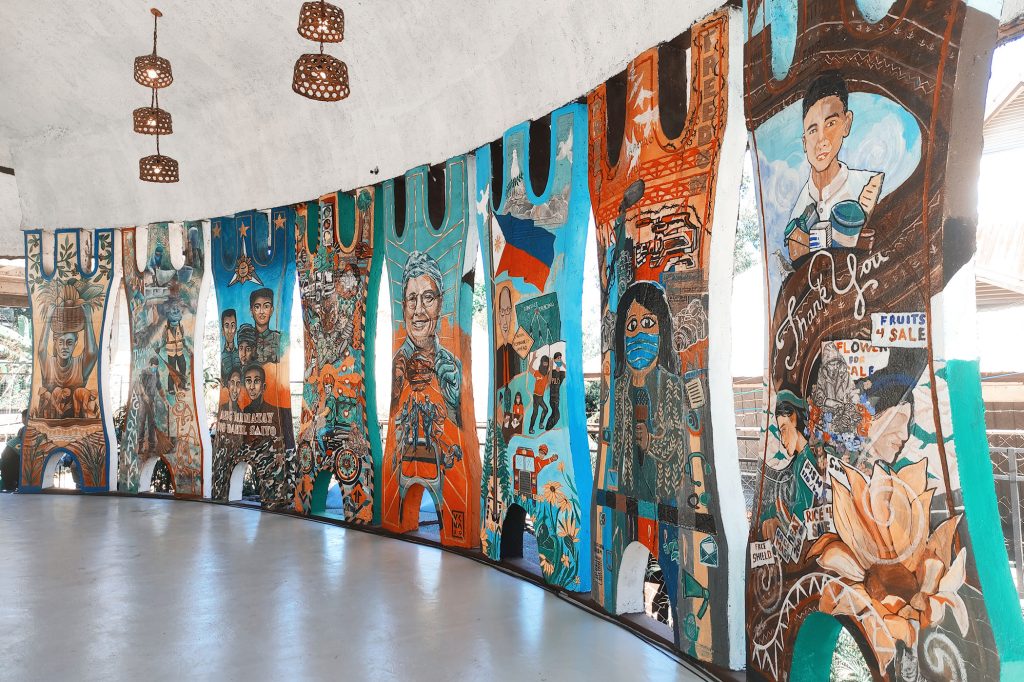
The newly restored Kalasag Murals in Baguio City's Sunshine Park are vibrant again. These eight shield-inspired pillars, designed by local artists of Baguio City, recognize the community's "modern-day heroes." Sunshine Park will reopen to the public on May 21, 2026, following months of renovation and enhancements.**Photo by neimless_skills
May 19, 2026 – The Philippines is experiencing the fastest-growing HIV epidemic in the Asia-Pacific region. This is according to the World Health Organization (WHO) and the Joint United Nations Programme on Human Immunodeficiency Virus-Acquired Immunodeficiency Syndrome (UNAIDS), as reported in a press conference on May 14 at a local venue.
The panelists at the press conference were Darwin Babon, Development Management Officer (DMO) III from the Department of Health – Cordillera Administrative Region (DOH-CAR); City Health Services Office (CHSO) head Dr. Celia Flor Brillantes; Dr. Clement Bilalat, Medical Officer IV of the CHSO; and John Raspado of Salakniban Project Namnama, an advocacy and support group for HIV-AIDS patients and their families.
In the Philippines, an estimated 217,700 People Living with AIDS (PLAID) were recorded, with 30,800 or 555 percent representing new infections and 2,300 or 667 percent reflecting the increase in AIDS-related deaths from 2010 to 2024. These figures are drawn from global data on HIV-AIDS cases, which show 40.8 million PLAID, 1.3 million individuals with new infections, and 630,000 AIDS-related deaths during the same period.
AIDS is the most advanced stage of the sexually transmitted infection in which the Human Immunodeficiency Virus (HIV) severely weakens the immune system, destroying the body’s ability to fight off infections and diseases.
National data from UNAIDS show 55 new cases per day. In terms of gender proportion, from January 1984 to December 2025, AIDS cases include 154,296 males, accounting for 94 percent of total cases. Forty-two percent are in the 25 to 34 age bracket.
Regional data from the DOH-CAR lists the top municipalities and cities with PLAID, with Baguio having 800 or 56.3 percent; La Trinidad, Benguet with 102 or 7.1 percent; Bangued, Abra with 74 or 4.8 percent; Tabuk, Kalinga with 52 or 3.5 percent; and Tuba, Benguet with 37 or 2.5 percent.
From 1984 to 2020, there were no new cases recorded, with a cumulative total of 415 cases and 19 deaths. In 2021, there were 70 new cases, bringing the total to 485, with four deaths.
In 2022, 86 new patients were added for a cumulative total of 570, with six deaths. In 2023, there were 63 new patients, bringing the total to 633, with five deaths. In 2024, there were 80 new patients for a cumulative total of 713, with no deaths. In 2025, there were 87 new patients for a cumulative total of 800, with five deaths.
A total of 39 deaths were recorded through 2025.
According to Dr. Bilalat, an estimated 1,300 AIDS cases exist in the region, with 800 identified and 500 still being located.
The modes of transmission for AIDS include male-to-female sex, male-to-male or female-to-female sex, mother-to-child transmission, blood transfusion, drug use, contaminated needles, and some cases with unknown causes.
DOH representative Babon, Dr. Brillantes, and Raspado stated they are working together to curb the alarming increase in AIDS cases through awareness campaigns for testing, antiretroviral therapy, pre- and post-exposure prophylaxis, and by advocating the use of condoms, limiting of sexual partners, harm reduction programs, and treatment of STIs.
Other data sources include the DOH National AIDS and Sexually Transmitted Infection (STI) Prevention and Control Program (NASPCP) and the Philippine HIV and AIDS Surveillance Reports (PAHI).
A parade from Upper Session Road to People’s Park, followed by a candlelighting ceremony, was held after the press conference.
The theme, “Keeping the Light Alive,” is a commemoration of those who have passed due to illness.** jgfianza