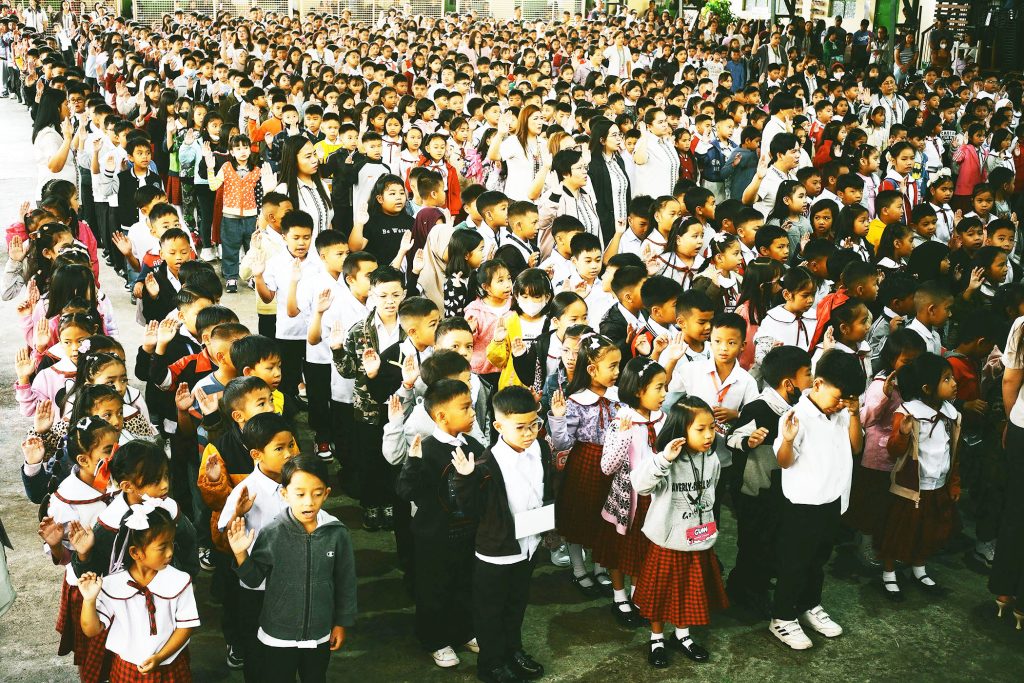
Baguio Central School (BCS) welcomed thousands of learners for the start of the new academic year. In total, there are 334,949 recorded learners in the Cordillera region as of June 10, 2026 by the DepEd CAR. **Photo by neimless_skills
2,030 more classrooms needed
BAGUIO CITY (PIA) — The Department of Education in the Cordillera Administrative Region welcomed more than 200,000 learners in public schools across the region during the opening of classes for School Year 2026–2027 on Monday, June 8.
Authorities describe the opening of classes as smooth and orderly, with police personnel deployed in streets and near schools to ensure safety and security. Top regional and provincial DepEd officials undertook monitoring operations and assessed the overall learning environment on the first day of classes in different schools.
DepEd-CAR Regional Director Nicolas T. Capulong led the monitoring of the opening of classes at the Baguio City National High School, the biggest public school in Baguio City, and at the Quezon Elementary School.
The schools division superintendents also led the checking on the preparedness of schools and classroom conditions in their respective areas.
According to DepEd, these visits highlight the agency’s commitment to placing learners at the center of its efforts, ensuring that schools are ready to deliver quality education in a safe, supportive, and conducive learning environment.
The readiness of schools in welcoming learners back for the new school year is one of the goals of the Oplan Balik Eskwela, the annual initiative designed to ensure schools are safe, clean, and ready for learners.
Preparations include general cleaning, repainting of classrooms, assembly and repair of school furniture, and fixing of roofs in anticipation of the rainy season.
Rose Melody Flores, Officer-In-Charge of the Policy, Planning, and Research Division of DepEd-CAR, in an interview, said that infrastructure development remains the region’s biggest challenge.
Data shows that DepEd-CAR has 14,648 existing classrooms, but requires an additional 2,030 classrooms to fully meet the region’s needs and planning standards.
Compounding the shortage is the damage caused by natural calamities, particularly earthquakes, which left many school structures unsafe or in need of major repairs.
“Our major damages are mostly related to school sites. Many require slope protection measures because of seismic activity, while some schools are being considered for total relocation,” Flores explained.
She cited the Abatan Elementary School in Benguet and Dalican National High School in Mountain Province, which need immediate slope protection interventions.
Regional officials are already studying site relocation options for the Acupan Elementary School in Benguet, after the school sustained heavy damage during previous earthquakes.
“These are major concerns we are addressing. We need to ensure that by the time students enter, every facility is safe and ready to use,” she added.
For minor repairs and maintenance, the agency relies heavily on community participation under Brigada Eskwela, where volunteers help fix fixtures, repaint rooms, and improve school grounds.
Flores emphasized that despite the gaps, the agency is utilizing data-driven planning to prioritize which schools receive funding, repairs, and new facilities first, ensuring that no community is left behind as the new school year begins. **JDP/MAWC-PIA-CAR