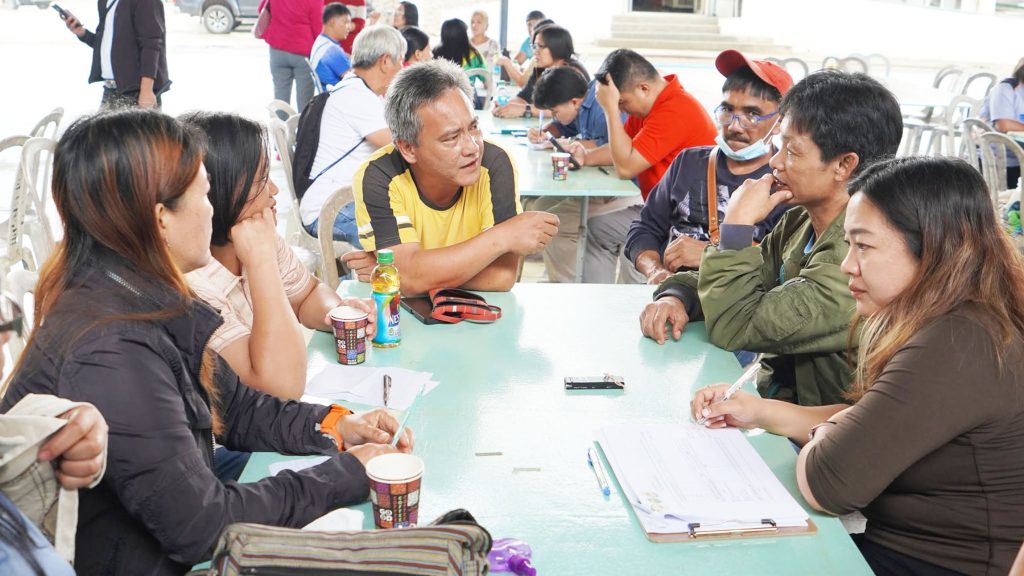
KAPANGAN, Benguet – Around 40 stakeholders from six agrarian reform communities (ARCs) in the Municipality of Kapangan gathered on July 16, 2026, to help craft strategic investment plans for the coffee and cacao industries under the Department of Agrarian Reform’s (DAR) Value Chain Innovation for Sustainable Transformation in Agrarian Reform Communities (VISTA) Project.
Held at the Kapangan Multipurpose Gym in Barangay Paykek, the activity marked the third day of the Participatory Planning and Focus Group Discussion (FGD) on the identification and prioritization of strategic investments that will strengthen the municipality’s coffee and cacao value chains while promoting sustainable and inclusive agricultural development.
The consultation was spearheaded by the Department of Agrarian Reform Provincial Office (DARPO)–Benguet under the leadership of Provincial Agrarian Reform Program Officer II Lailani A. Cortez, in partnership with Orient Integrated Development Consultants, Inc. and the Benguet State University–Institute of Social Research and Development (BSU-ISRD).
The participatory planning session gathered firsthand insights from coffee and cacao growers on indigenous farming knowledge, existing production practices, market opportunities, and challenges confronting the local industries. The discussions also generated baseline information that will guide the formulation and implementation of strategic investment plans under the VISTA Project to enhance productivity, improve market access, and increase the resilience of agrarian reform communities.
A highlight of the activity was the presentation of the results of the biodiversity assessment and key informant interviews (KIIs) conducted on July 13–14, 2026, in Barangay Caliking, Atok, and Barangay Sagubo, Kapangan. Dr. Leonard Florence and Forester Jomar Guzman shared findings showing the presence of diverse beneficial flora and fauna, indicating that both areas provide favorable ecological conditions for coffee pollination and natural seed dispersal.
The researchers emphasized the need to conserve biodiversity by protecting naturally growing coffee wildlings and preserving the area’s forest ecosystem, recognizing their vital role in sustaining coffee production and ensuring the long-term viability of the local coffee industry.
Participants represented the barangays of Gadang, Labueg, Sagubo, Cuba, Datakan, and Taba-ao. They included representatives from the municipal and barangay local government units led by Municipal Mayor Hon. Harris Dizon, who personally attended the activity, as well as officials from the DAR-Cordillera Administrative Region (DAR-CAR) VISTA Regional Project Management Office (RPMO), Agrarian Reform Beneficiary Organizations (ARBOs), Indigenous Peoples’ Mandatory Representatives (IPMRs), and women’s and youth organizations.
The broad participation of stakeholders ensured that the proposed investment strategies reflect the needs, priorities, and aspirations of farming communities while strengthening collaboration among government agencies, local government units, and community organizations.
The VISTA Project, an initiative of DAR funded through the International Fund for Agricultural Development (IFAD), aims to transform agrarian reform communities into productive, climate-resilient, and market-oriented rural enterprises by investing in priority agricultural value chains, strengthening farmer organizations, and promoting sustainable resource management.**