The Panahon ng Pagkilos: Philippine Community Resilience Project (PCRP), a climate adaptation initiative of the Department of Social Welfare and Development (DSWD) under the Kapit-Bisig Laban sa Kahirapan-Comprehensive and Integrated Delivery of Social Services (KALAHI-CIDSS) program, underwent a project review with the World Bank during the second Implementation Support Mission (ISM) held from 29 September to 2 October 2026 in the Cordillera Administrative Region.
The mission included document review of Municipal Resilience Plans (MRPs) and Participatory Risk and Vulnerability Assessment (PRVA) results, followed by field validation of identified target sites in Benguet. The activities assessed how community-identified risks were reflected in municipal resilience planning and how the proposed resilience investments respond to the priority risks identified through the participatory process.
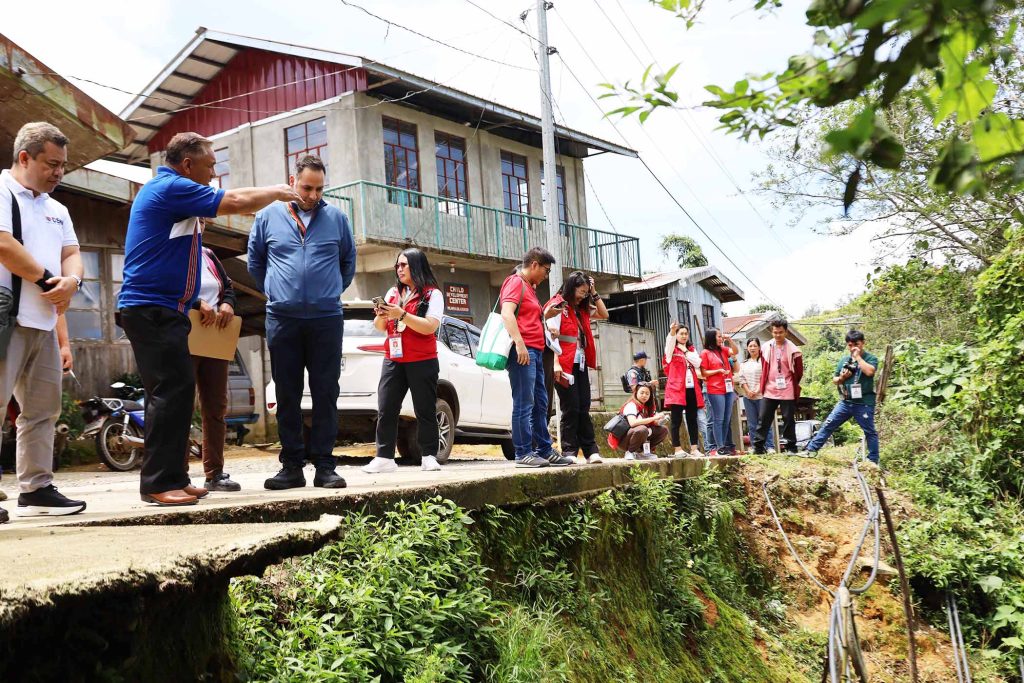
The field validation focused on selected target sites in the municipalities of Bokod and Buguias, Benguet, where the mission team met with local officials, community volunteers, and other stakeholders to validate the identified risks and proposed interventions.
On 30 September, the team visited Barangays Bila and Ambuclao in Bokod to validate proposed resilience investments identified through the Municipal Resilience Plan. In Bila, the team visited the proposed Construction of Slope Protection, while in Ambuclao, the proposed Concreting of Foot Trails with Railings was presented for validation.
Meanwhile, in Buguias, the team proceeded to Barangays Lengaoan and Amgaleyguey on 1 October. In Lengaoan, the team validated the proposed Improvement of Access Road and visited the sinking area in Sitio Pilando, an identified risk area in the community. In Amgaleyguey, the team validated the proposed Improvement of Slope Protection and Storm Drainage Canal.
During the field validation, World Bank Senior Water Specialist Georges Comair, PhD, emphasized that the mission was not simply an observation activity but an opportunity to work with communities in identifying challenges and finding practical, community-owned solutions.
“Pagkilos, which means action, is a landmark initiative led by the DSWD with strong support from the World Bank. It builds on the proven community-driven development approach of KALAHI-CIDSS and the goal is clear: to strengthen the capacity of vulnerable communities like yours to plan for resilience, identify climate and disaster risks and invest in solutions that protect lives, livelihoods, and our future,” he said.
He also acknowledged the contribution of community volunteers, noting that their time, energy, and commitment are central to the implementation of the project.
The mission also provided an opportunity for DSWD to clarify implementation concerns and identify areas where technical assistance and policy guidance may be needed. Assistant Secretary for Promotive Programs Edmon B. Monteverde called for open communication among the Regional Program Management Office (RPMO), Area Coordinating Teams (ACTs), and National Program Management Office (NPMO) as implementation progresses.
“This is an opportunity for us to clarify the matters and concerns that we have encountered in the course of implementing the PCRP, especially as we navigate the different processes involved in its implementation. I hope these can be addressed through the assistance of the RPMO, ACTs, and NPMO, particularly in providing technical assistance and developing the necessary policy guidelines. Let us maintain open communication as we move forward with the implementation of PCRP,” he said
The World Bank delegation was led by Comair and Social Development Specialist Josephine Jade. They were joined by the DSWD Central Office, the KALAHI-CIDSS NPMO, the DSWD FO CAR RPMO, ACTs, and a representative from the Department of Economy, Planning, and Development (DepDev), a member of the Regional Steering Committee.
The mission concluded with an Exit Conference on 2 October 2026 in Baguio City, where the World Bank team presented observations and recommendations from the technical review and field validation.
DSWD Field Office CAR OIC Regional Director Enrique H. Gascon Jr. emphasized that the mission also reflected the Cordilleran values of Dap-ay, a space for dialogue and collective decision-making, and Binnadang, the spirit of helping one another toward a common purpose.
“PCRP is about building resilience with communities, not simply for communities, and doing so through genuine partnership among government, development partners, local governments, and the people we serve,” RD Gascon said.
The mission’s findings and agreements will guide the succeeding implementation of PCRP as DSWD KALAHI-CIDSS and its partners continue to strengthen community resilience across the Cordillera. **By Yvonne Gracious T. Elegado, Project Development Officer III