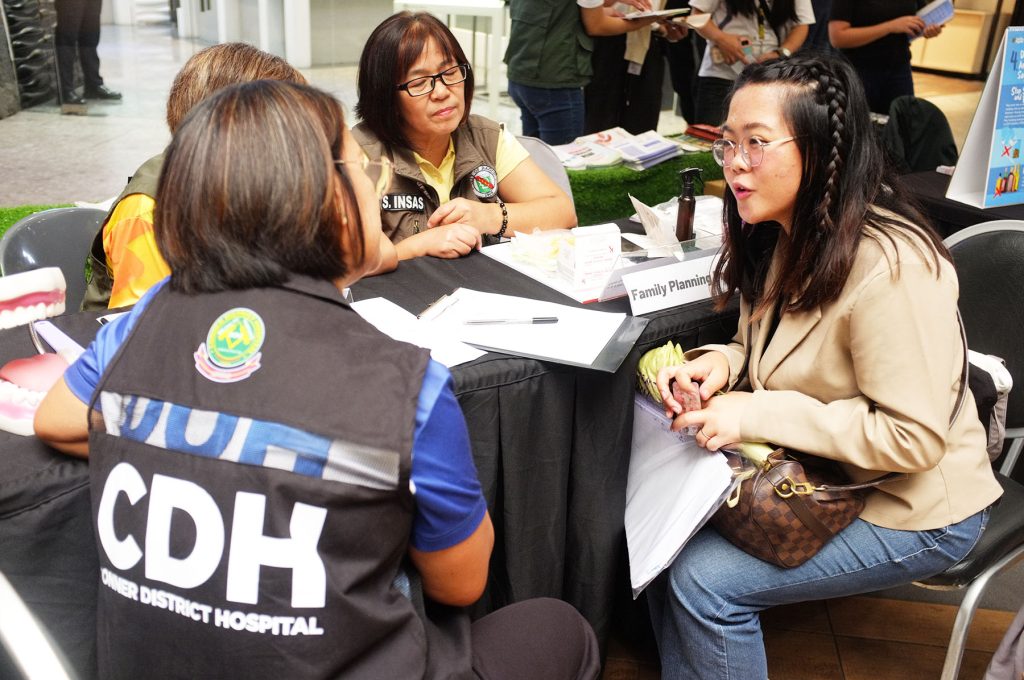
The DOH National Job Fair, held on June 25, 2025, in the SM City Baguio Atrium to commemorate the Department of Health's 127th anniversary, offered a variety of job opportunities and free health services. **Photo by neimless_skills
As the city government grapples with waste disposal problems, a new solid waste facility has expressed willingness to accept the city’s waste following the sudden cessation of operations of Metro Waste Solid Waste Management Corporation, the company that manages the Urdaneta City Sanitary Landfill where the city previously hauled its waste.
During its regular session on June 23, 2025, the Baguio City Council approved a resolution authorizing Mayor Benjamin Magalong to enter into a memorandum of agreement (MOA) with MAA Integrated Waste Solutions Corporation to hasten the hauling of waste from the city’s transfer station to the company’s Materials Recovery Facility (MRF) in Urdaneta City, Pangasinan.
The MOA will be confirmed by the city council once it is signed by both parties.
At present, the city hauls its waste to Prime Waste Solutions in Porac, Pampanga. The partnership was formalized through a MOA under emergency procurement, prompted by the need to address the garbage buildup at the transfer station following the cessation of operations by Metro Waste Solid Waste Management.
However, according to General Services Officer Eugene Buyucan, the longer turnaround time for the city’s dump trucks has led to further accumulation of waste at the transfer station.
Since the new facility is closer, it is expected to help resolve the current problem. Under the MOA with MAA Integrated Waste Solutions Corporation, the city may haul three to four truckloads of garbage to the new site. The tipping fee for residuals is set at P550 per ton, the same rate offered by Prime Waste Solutions Corporation and lower than Metro Waste’s P650 per ton.
In an interview, Buyucan explained that the city will dispose of up to 200 tons of waste per day to MAA Integrated Waste Solutions Corporation in Urdaneta City (the new facility). Any excess waste generated by the city will be hauled to Prime Waste Solutions in Porac, Pampanga as a secondary option. This will be the arrangement for the time being, he said.
Buyucan said that if Metro Waste’s landfill resumes operations, the city plans to shift back to Metro Waste because it generates lower hauling costs due to its proximity compared to Porac, Pampanga.
In its memorandum dated June 2, 2025, Metro Waste Solid Waste Corporation apologized to its clients for the “temporary” disruption in landfill operations due to scheduled maintenance and inspection work which was necessary to ensure the safety, efficiency, and environmental compliance of the landfill.
More Self-Reliant and Sustainable Solutions Underway
In response to questions about the city’s long-term waste disposal plans, Buyucan explained that while the city currently relies on two solid waste facilities, there are broader efforts underway to improve waste management.
For the management of biodegradable waste, Buyucan emphasized that barangays are primarily responsible as mandated by the Ecological Solid Waste Management Act of 2000 (RA (RA 9003) and the city’s Environment Code (Ordinance 18-2016) which require that biodegradable waste be managed at the household and barangay level.
He acknowledged concerns raised by some barangays about the lack of land for composting but pointed out that several alternative methods are available such as vermiculture, bokashi, and black soldier fly technology. He encouraged barangays to seek support from the City Veterinary and Agriculture Office (CVAO) to explore these options.
On the city’s part, he shared that a centralized MRF is being developed in Dontogan Barangay as part of the long-term solution for managing residual waste. Once the MRF is completed, it will serve as the city’s main facility for handling its waste.
Additionally, the city is exploring the acquisition of a biodigester machine for biodegradable waste in Irisan Barangay, although this would require a larger budget and compliance with environmental regulations.
He also mentioned a technology offered by a company which can convert food waste into compost within 24 hours.
As the city continues to deal with immediate waste disposal challenges, it is also eyeing more sustainable and long-term solutions. With efforts to strengthen barangay-level biowaste management and the ongoing development of its own facilities, the city hopes to gradually reduce its reliance on external landfills and move toward a more self-reliant and environmentally responsible waste management system. **Jordan G. Habbiling